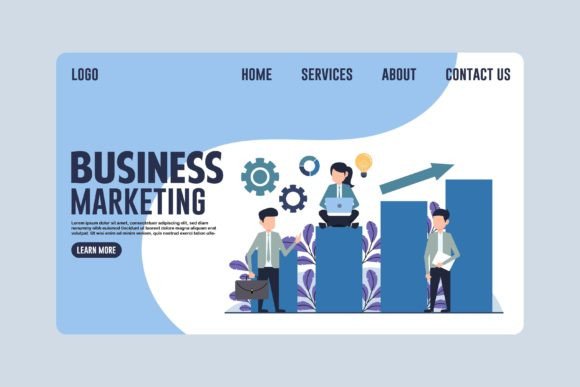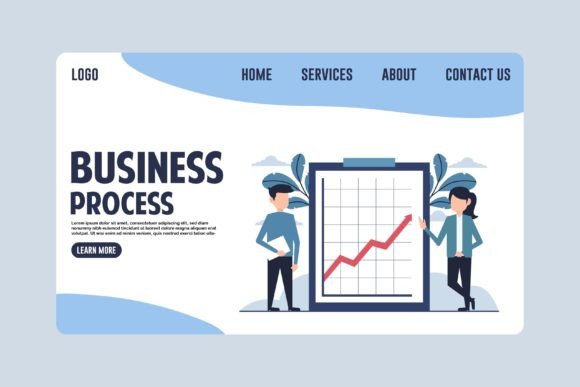
Mastering the Landing Page Design Business Process
In the fast-paced world of digital marketing, a landing page is often the make-or-break moment for your campaign. It is the first impression a potential customer has of your offer, and it needs to communicate value instantly. The Landing Page Design Business Process is not just about making things look pretty; it is a strategic workflow that aligns visual storytelling with conversion goals. Whether you are an entrepreneur launching a new product or a marketer optimizing an ad funnel, understanding this process is essential for success. When executed correctly, it transforms casual visitors into loyal customers.
However, the path to a high-converting page can be cluttered with technical hurdles and design limitations. This is where having access to flexible, high-quality assets becomes a game-changer. Imagine a toolkit where every single element is 100% vector-based. This means you are not stuck with pixelated images that blur when you zoom in. Instead, you gain the freedom to transform, scale up or down, add or remove elements, and recolor without losing a single bit of quality. This level of control is what separates amateur designs from professional-grade visuals.
The Core Value of Vector-Based Design Assets
At the heart of a robust Landing Page Design Business Process lies the flexibility of the assets you use. Traditional raster images, like JPEGs or PNGs, have fixed resolutions. If you need to stretch a hero image to fit a wider screen or shrink a banner for a mobile device, you risk compromising clarity. Vectors operate differently. They are defined by mathematical equations rather than a grid of pixels, allowing them to remain crisp at any size.
This scalability is crucial for modern web environments. Your audience accesses content on a vast array of devices, from massive desktop monitors to compact smartphones. A design template built entirely on vector graphics ensures consistency across all platforms. You can take a complex illustration meant for a desktop hero section and effortlessly adapt it for a mobile web banner without the dreaded "blocky" look. This adaptability streamlines your workflow, saving hours of re-rendering and resizing.
Furthermore, the ability to edit these files directly in any standard vector graphics software opens up a world of customization. You are not limited to the colors or layouts provided in the initial download. You can tweak a specific icon, change the typography within an illustration, or rearrange components to better match your brand identity. This creative autonomy allows you to maintain strict brand guidelines while still utilizing pre-made, high-quality structures.
Key Characteristics of Professional Design Templates
When evaluating resources for your projects, certain characteristics stand out as indicators of quality. A top-tier template for the Landing Page Design Business Process should offer more than just a static image. It must provide the source files necessary for true ownership and modification. Specifically, receiving 100 vector source files in EPS formats is a significant advantage. EPS (Encapsulated PostScript) is a widely supported format that preserves all vector data, ensuring compatibility with industry-standard tools like Adobe Illustrator, CorelDRAW, and Inkscape.
Beyond the source files, a comprehensive package should also include high-resolution JPG versions. These are perfect for quick previews, sharing with non-designer stakeholders, or embedding directly into content management systems where vector editing isn't required. Having both formats covers all bases: the raw power of editable vectors for the design phase and the convenience of ready-to-use rasters for deployment.
Another notable quality is the modularity of the elements. Good design templates break down complex scenes into individual layers and groups. This means if you want to remove a character from a business illustration or swap out a background color scheme, you can do so without disrupting the entire composition. This modularity supports the iterative nature of the design process, allowing for rapid testing and refinement based on user feedback.
Practical Applications Across Diverse Environments
The versatility of these vector assets extends far beyond a single webpage. The same design principles and file structures can be adapted for a multitude of purposes, making them a cost-effective investment for various professionals. Let's explore how these resources fit into different real-world scenarios.
- Web Graphics and Hero Images: The most obvious application is the landing page itself. A striking hero image sets the tone for the entire site. With vector files, you can create dynamic backgrounds that respond to user interactions or simply ensure that your main headline sits perfectly atop a crisp, scalable illustration.
- Mobile Web Optimization: Mobile traffic continues to dominate. Vector assets allow designers to create lightweight yet visually rich experiences that load quickly on cellular networks while remaining sharp on high-density Retina displays.
- Banners and Ad Creatives: Digital advertising requires assets in dozens of sizes. From Facebook ads to Google Display Network banners, the ability to scale a single vector master file to fit every specification without quality loss is invaluable for maintaining brand consistency across campaigns.
- Infographics and Educational Content: Educators and bloggers often need to explain complex processes. Vector illustrations are ideal for creating clear, legible infographics that guide the reader through data or steps in a logical flow.
- Print and Presentation Materials: While our focus is digital, vector files are print-ready. You can take the same assets used for your landing page and repurpose them for brochures, business cards, or pitch deck slides, ensuring your message looks professional everywhere.
Enhancing Usability and Brand Engagement
A well-executed Landing Page Design Business Process directly impacts user experience (UX). When visuals are clear, relevant, and responsive, users feel more confident navigating your site. High-quality graphics reduce cognitive load; they help users understand your value proposition quickly without struggling to decipher blurry or mismatched images. This clarity leads to higher engagement rates and lower bounce rates.
From a branding perspective, consistency is key. By using a cohesive set of vector assets, you reinforce your brand identity. Every time a user sees your specific color palette, style of illustration, or layout structure, it builds familiarity and trust. This is particularly important for startups and small businesses trying to establish authority in a crowded market. A polished, professional look signals competence and reliability.
Moreover, the efficiency gained from using editable vector templates translates to productivity. Instead of hiring a designer for every minor tweak or spending days creating assets from scratch, you can implement changes in minutes. This agility allows you to run A/B tests more frequently, trying different headlines, colors, or imagery to see what resonates best with your audience. The speed at which you can iterate is a competitive advantage in itself.
Strategic Considerations for Implementation
While the benefits of vector-based design are clear, successful implementation requires thoughtful planning. When selecting a template or asset pack, consider your long-term needs. Will you need to update these graphics frequently? Do you have the software skills to edit EPS files, or will you need to hire someone who does? Ensuring you have the right tools and knowledge base is part of the broader Landing Page Design Business Process.
It is also important to balance creativity with performance. While vector files are scalable, overly complex illustrations with thousands of paths can slow down page load times if not optimized correctly. Always test your final export settings to ensure the visual fidelity remains high without sacrificing speed. Simplicity often wins in web design; a clean, focused illustration is usually more effective than a cluttered one.
Finally, remember that design is only one part of the equation. Even the most beautiful landing page will fail if the copy is weak or the call-to-action is unclear. Use your vector assets to support your message, not distract from it. Align your visual hierarchy with your textual content to guide the user naturally toward the desired action. By integrating high-quality, flexible design assets into a strategic workflow, you create a powerful engine for growth that serves your business for years to come.