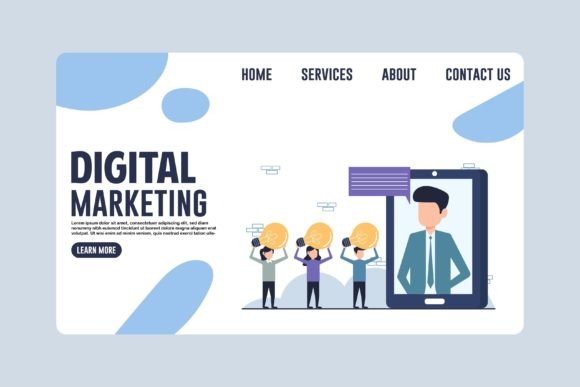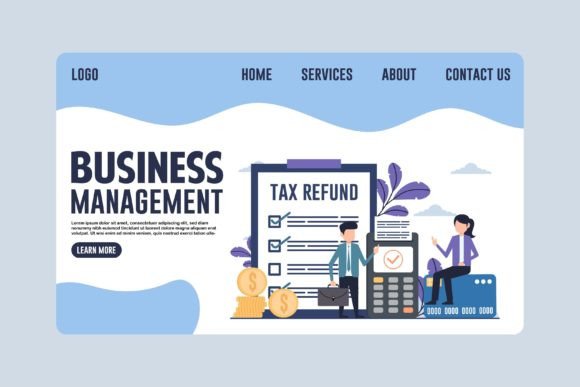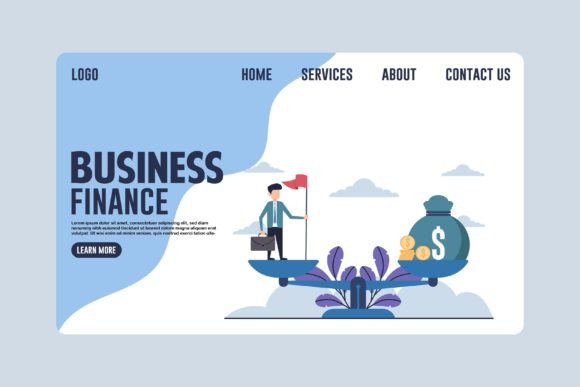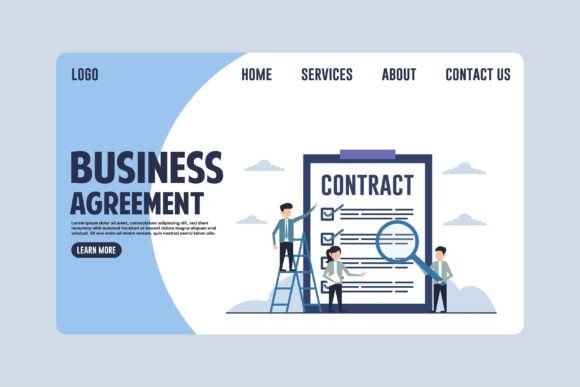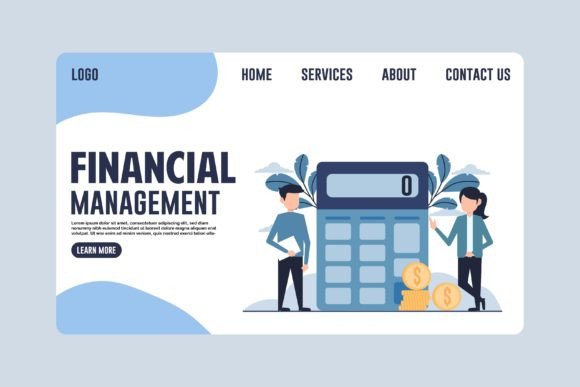
Landing Page Design Financial Management: The Power of 100% Vector Assets
In the competitive landscape of digital finance, the first interaction a potential client has with your service often determines the trajectory of the entire relationship. This is where Landing Page Design Financial Management becomes critical. It is not merely about arranging charts and graphs; it is about communicating stability, growth, and trust through visual language. As financial institutions and fintech startups race to capture attention, the demand for high-quality, adaptable visuals has never been higher. Modern audiences expect interfaces that are crisp on every device, from large desktop monitors to the smallest mobile screens. Meeting this expectation requires a shift away from static, pixel-based imagery toward scalable, intelligent design assets.
The core advantage in today's market lies in utilizing resources where all elements on the design template are 100% vector. Unlike traditional raster images that degrade when resized, vector graphics maintain perfect clarity regardless of scale. For professionals managing complex financial data or marketing teams launching new investment products, this technical distinction translates directly into brand integrity. When you can transform, scale up or down, add or remove elements, and recolor without losing quality, you gain the agility to respond to market shifts instantly. This flexibility is no longer a luxury; it is a fundamental requirement for effective digital communication in the financial sector.
The Evolution of Visual Communication in Finance
Historically, financial reporting and marketing materials were dominated by dense spreadsheets and static PDFs. While informative, these formats often failed to engage users emotionally or visually. The evolution of Landing Page Design Financial Management reflects a broader trend in the industry: the humanization of data. Today's investors and clients do not just want numbers; they want narratives. They want to see their wealth growing, their risks mitigated, and their future secured through compelling visual storytelling.
This shift has driven a change in creative practices. Designers and business owners are moving away from one-off illustrations created for a single campaign. Instead, there is a strong preference for modular systems that can be reused and adapted. A graphic used for a desktop hero image might need to be simplified for a mobile web banner or expanded into a detailed infographic for a whitepaper. With a robust library of vector sources, creators can achieve this fluidity effortlessly. The ability to manipulate individual components—such as changing the color of a rising stock arrow to match a rebranded logo or removing a specific icon to declutter a mobile view—ensures that the message remains clear across all touchpoints.
Why Scalability Matters for Modern Workflows
Consider the workflow of a modern marketing team. They are often juggling multiple channels simultaneously: social media ads, email newsletters, website banners, and presentation decks. In the past, resizing an image for a different format meant risking blurriness or pixelation. This was particularly problematic for financial management visuals, where precision is paramount. A blurry graph undermines credibility. By leveraging a template where all elements are 100% vector, teams eliminate this risk entirely.
You can easily edit vector files in any vector graphics software, allowing for rapid iteration. If a client requests a change in the color scheme to align with a new corporate identity, the process is immediate. There is no need to recreate the artwork from scratch. You can simply select the element and apply the new hue. Similarly, if a landing page needs to be optimized for a dark mode interface, the contrast and colors can be adjusted without compromising the sharpness of the lines or icons. This efficiency saves time and reduces costs, allowing businesses to focus on strategy rather than technical limitations.
Practical Applications Across Digital Platforms
The versatility of high-quality vector assets extends far beyond a single webpage. These tools are essential for a wide array of project types, including web graphics, mobile web layouts, landing pages, banners, hero images, and infographics. Each of these applications presents unique challenges regarding resolution and layout, but a unified vector source file solves them all.
- Web Graphics and Mobile Web: Mobile traffic now accounts for a significant portion of internet usage. On small screens, space is at a premium. Vector graphics allow designers to scale down complex financial illustrations so they remain legible on a smartphone without becoming a muddy mess. This ensures that a user checking their portfolio on the go receives the same professional experience as someone viewing it on a desktop.
- Landing Pages and Hero Images: The "above the fold" area of a landing page is prime real estate. A striking, high-resolution hero image can stop a visitor in their tracks. Because vector files can be scaled up to massive dimensions without quality loss, they are perfect for full-width background images that look stunning on 4K displays.
- Banners and Ads: Advertising platforms require various aspect ratios and sizes. From square Instagram posts to wide leaderboard ads, having a master vector file means you can generate all necessary variations quickly. You can crop, rearrange, or resize elements to fit the specific constraints of each ad network while maintaining visual consistency.
- Infographics: Explaining complex financial concepts like compound interest, asset allocation, or tax strategies requires clear, detailed visuals. Infographics benefit immensely from vector technology because they often involve intricate lines, precise typography, and layered data points. Being able to add or remove text and elements allows for customization based on the specific audience or regulatory requirements.
Enhancing User Experience Through Precision
User expectations have evolved alongside technology. Today's internet users are visually literate and sensitive to low-quality design. In the context of financial management, where trust is the currency, a poorly rendered image can signal incompetence or negligence. Conversely, a clean, sharp, and well-structured visual communicates professionalism and attention to detail.
When you utilize a design package that includes 100 vector source files in EPS formats, you are investing in long-term usability. These files serve as a master blueprint. Whether you are a freelancer creating a custom site for a startup or a large corporation updating its annual report, the ability to access the underlying structure of the graphic provides peace of mind. You know that no matter how the project evolves, the visual foundation will hold up. Furthermore, the inclusion of high-resolution JPG files ensures that you have ready-to-use versions for immediate deployment, bridging the gap between raw editing and final publication.
Strategic Advantages for Entrepreneurs and Professionals
For entrepreneurs and business owners, time is a finite resource. The ability to rapidly deploy high-quality visuals gives a competitive edge. In the fast-paced world of fintech, trends change quickly. A design that looks fresh today might need a tweak tomorrow to reflect a new market sentiment. With editable vector files, you are not locked into a static design. You can adapt your visual identity as your business grows.
Moreover, the cost-effectiveness of using comprehensive vector libraries cannot be overstated. Hiring a designer to create ten different variations of a financial illustration can be expensive. However, with a versatile set of source files, a single designer—or even a skilled business owner—can produce those variations in a fraction of the time. This democratization of high-end design allows smaller firms to compete visually with larger institutions. It levels the playing field, ensuring that the quality of communication is determined by creativity and strategy rather than budget alone.
Future-Proofing Your Digital Assets
As we look toward the future of digital design, the importance of resolution independence will only grow. With the proliferation of high-density displays, virtual reality interfaces, and immersive web experiences, the demand for graphics that can scale infinitely without degradation is increasing. Raster images will increasingly become obsolete for primary interface elements.
Adopting a workflow centered around Landing Page Design Financial Management with 100% vector assets is a forward-looking decision. It prepares your business for technologies and platforms that may not even exist yet. Whether you are designing for a standard website today or an augmented reality banking app tomorrow, the principles of scalability and editability remain constant. By choosing formats that prioritize flexibility and quality, you ensure that your visual assets remain relevant and effective for years to come.
In conclusion, the intersection of financial management and digital design requires more than just aesthetic appeal; it demands technical precision and strategic adaptability. By embracing templates where all elements are 100% vector, professionals can create compelling, trustworthy, and versatile visual communications. From transforming and scaling elements to recoloring for brand alignment, the freedom offered by vector graphics empowers creators to meet the diverse needs of modern audiences. Whether for a simple banner or a complex infographic, these tools provide the foundation for success in an increasingly visual digital economy.